
Eiheiji Temple
Researched and written by Hinato
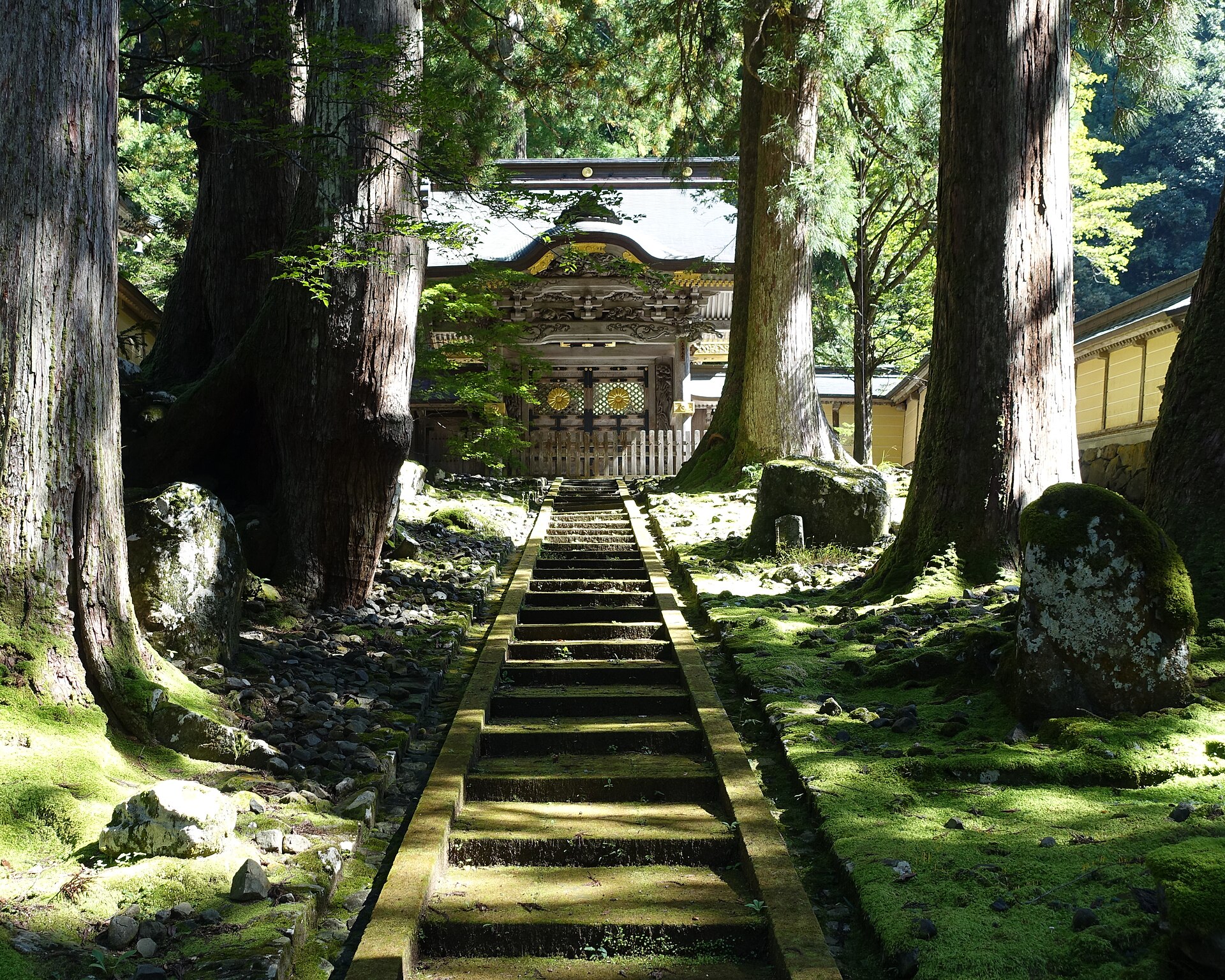
Photo: Douglaspperkins / Wikimedia Commons (CC BY-SA 4.0) · original
Before Eiheiji Temple became a stop on any list, it was — and still is — a working place of worship in Fukui.
Eiheiji is a working Zen monastery founded in 1244, where 150-200 monks follow a training schedule unchanged since the Edo period: wake at 3:30am for meditation, nine zazen sessions throughout the day, communal meals eaten in silence, manual labor sweeping halls and tending gardens. This is not a museum. The monks live here year-round, and visitors follow a prescribed route through the complex — past the Sanmon gate, through the Dharma Hall where morning chanting echoes from rooms you can't enter, along covered wooden corridors worn smooth by 700 years of footsteps.
The architecture embodies Zen principles: no decoration, no wasted space, every beam and post placed with purpose. The Monks' Hall (Sodo) has rows of tatami platforms where monks sleep and meditate, each space exactly the width of one person lying down. If you visit during morning hours (7:00-9:00), you'll hear the chanting — 150 voices in unison reciting sutras, the sound reverberating through wooden halls and vibrating the floor under your feet. It's the closest most people get to experiencing monastic life without actually joining the monastery.
What to know before you visit
Opening hours
8:30 AM – 4:30 PM (last entry 4:00 PM) | Early morning ceremony observation: 7:00 AM on select days | Three-day retreat: starts Sunday 3:30 PM
Closed: Open year-round | New Year period may have restricted access — check website
When to go
Autumn (October–November) for maple foliage in temple grounds | Winter (December–February) for snow-covered silent atmosphere | Year-round for spiritual immersion
Admission fee
¥700 adults | Discounted child rates available — confirm current pricing on official site | Three-day zazen retreat: ¥9,000 (all meals + lodging included) — confirm current pricing before booking
How long to allow
60–90 minutes (self-guided) | 3 days (full retreat experience)
How to reach it
Getting there in detail
Full directions & timing
Nearest Station
Fukui Station (JR Hokuriku Line / Shinkansen) — 30-min Keifuku Bus to Eiheiji (¥720 one-way)
Travel Time
From Tokyo: Hokuriku Shinkansen to Tsuruga + transfer (3.5 hrs total) | From Osaka: JR Thunderbird to Fukui (2.5 hrs) | From Kanazawa: 45 min JR Hokuriku Line
How to Get There
Bus: Keifuku Bus 'Eiheiji Line' from Fukui Station (30 min, ¥720 one-way, 12 buses daily). Return buses match temple closing time. Car: Hokuriku Expressway Fukui IC, then Route 416 east (25 min). Temple parking ¥500/2 hours. Taxi: Fukui Station to Eiheiji approx ¥3,500–4,000 (20 min).
Best Time to Visit
Arrive 8:30 AM opening to experience the temple before tour groups arrive at 10:00 AM. Early morning (7:00 AM on ceremony days) for sutra chanting — check temple website for schedule.
Crowd Avoidance Tips
Tour groups arrive 10:00 AM–12:00 PM. The corridor and main halls become congested. Beat crowds by arriving at opening or visiting after 2:30 PM when tour groups depart. Retreat participants see the temple at its most authentic (3:30 AM, no tourists).
Parking Information
Temple parking lot: ¥500 per 2 hours. Limited spaces — can fill on weekends and Golden Week. Bus from Fukui Station is more convenient and avoids parking stress.
What locals know
Book Your Stay Nearby
Find accommodation close to Eiheiji Temple on these trusted booking platforms:
Nearby Spots
The closest hidden gems to Eiheiji Temple, by straight-line distance.
Taniguchiya
Little knownFukui eats more fried tofu per household than any other prefecture in Japan, by a wide margin, and the reason is partly…
 ノボホショコロトソ / CC BY 4.0
Sauce Katsudon
Little knownSauce katsudon is Fukui's regional soul food and the polar opposite of the egg-bound katsudon known elsewhere in Japan.…
 藤谷良秀 / CC BY-SA 4.0
Oroshi Soba
Little knownEchizen oroshi soba is Fukui's traditional buckwheat noodle dish, defined by the use of coarsely grated daikon radish mi…
 藤谷良秀(Yoshihide Fujitani) / CC BY-SA 4.0
Yokokan Garden
Little knownYokokan (養浩館庭園) is the former villa garden of the Matsudaira clan, feudal lords who ruled Fukui Domain for 270 years dur…
Fukui City Ruins Museum
Little knownThe Fukui City History Museum (福井市立郷土歴史博物館) features a unique exhibition format: the museum building was constructed dir…
 掬茶 / CC BY-SA 4.0
Ichijodani Asakura Clan Ruins
Little knownIchijodani (一乗谷) was the castle town of the Asakura clan, who ruled Echizen Province (now Fukui) for 103 years (1471–157…
More in Fukui
 MathieuMD / CC BY-SA 4.0
Hakusan Heisenji
Little knownIn the medieval period Heisenji was one of the largest religious complexes in Japan — six thousand monks, forty-eight ha…
 663highland / CC BY 2.5
Kumagawa-juku
Locally knownBefore refrigeration, the mackerel landed at Obama on the Sea of Japan was salted and carried on foot over the mountains…
Echizen Ono Castle
Little knownOno sits in a mountain basin, and on cold still mornings from autumn into spring the basin fills with cloud while the ca…