
Shopping
Markets, shopping streets, crafts, and local specialties
45 spots
Shopping spots on this site are places worth visiting for what they sell and how they sell it, not just any retail location — traditional covered shopping streets (shotengai), craft districts built around a single regional specialty, morning markets, and long-running department stores or arcades that are themselves a piece of local history rather than a generic mall.
Shotengai are covered pedestrian arcades lined with small, often family-run shops and food stalls, and they function as a neighborhood's commercial heart in a way a shopping mall does not — expect a mix of everyday shops (produce, hardware, clothing) alongside anything aimed at visitors, which makes them a reliable way to see ordinary local life rather than a curated tourist strip. Craft districts, by contrast, are usually built around a single specialty tied to local materials or history: lacquerware, textiles, ceramics, knives, paper — and many workshops sell directly alongside larger retail shops, so prices and quality both vary more than at a uniform gift shop.
Cash remains more useful than card at smaller shops and market stalls, particularly outside major cities, and tax-free shopping for overseas visitors is generally only available at larger stores that display the tax-free logo and requires passport presentation at time of purchase. Morning markets (asaichi) run early, often finishing by mid-morning, and are concentrated in fishing towns along the Sea of Japan coast and in Wajima, Takayama and parts of Kochi.
Before you go
Shopping here means places that are worth visiting for what they are, not for what you can buy anywhere: covered shopping streets that are a neighbourhood's high street, craft districts built around one material, and morning markets that finish before most visitors have had breakfast.
The covered arcade, the shotengai, is the form to understand first. It is a roofed pedestrian street of small, mostly family-run shops — a greengrocer, a tofu maker, a shoe repairer, a stationer — with whatever is aimed at visitors mixed in among them rather than replacing them. It costs nothing to walk, it is open in the rain, and it is the most reliable way to see an ordinary Japanese neighbourhood at work.
Craft districts are the opposite proposition: one town, one material, several generations. Prices vary enormously in the same street because you are looking at a range from workshop seconds to pieces by a named maker, and the expensive one is expensive for reasons that are usually explicable if you ask.
Practical rules. Carry cash — small shops and market stalls still prefer it and some take nothing else. Tax-free shopping for visitors exists only at larger stores displaying the logo, requires your passport at the till, and has a minimum spend. Morning markets open very early and are packing up by mid-morning; arriving at eleven means an empty car park. And many small shops close one weekday, often irregular, which is why a craft street can be half shuttered on a Wednesday.
Choosing your first one
Decide whether you are buying or looking, because it changes the answer completely.
If you are looking — and for a first outing, looking is the better plan — take a covered arcade in a regional city over any craft destination. It is free, it takes an hour, it is indoors, it is open when everything else has shut for the afternoon, and it will tell you more about how the place lives than any museum. The best time is late afternoon, when the food shops are busy and people are buying dinner.
If you are buying, choose the town that makes the thing rather than the shop that sells it. Ceramics, lacquer, knives, textiles, paper: at the source the range is wider, the prices are better, and you can usually see it being made, which is what makes the object worth carrying home. Check the workshop's opening days before travelling, because a working studio is not a shop and many close midweek.
Two practical criteria on top of that. Prefer a market or district you can reach by train, since these are exactly the places where parking is difficult and the streets are narrow. And if a morning market is on your list, build the day around it rather than fitting it in — it is over by ten, and there is no second chance later.
Leave department stores and outlets for a wet afternoon. They are excellent and they are not why you came.
Common mistakes
Arriving at a morning market mid-morning. They start before dawn and finish by ten. This is the single most common wasted journey in this category.
Assuming shops keep weekend hours. Small independent shops close one weekday and it is frequently not Monday. A craft street on the wrong day is a row of shutters.
Expecting tax-free everywhere. It applies at participating larger stores, needs a passport and a minimum spend, and is not available at the small workshops where you will actually want to buy things.
Turning up cashless. Market stalls, small workshops and older arcade shops are cash businesses. Withdraw before you go; rural ATMs have their own opening hours.
Handling craft goods carelessly. Ask before picking up ceramics or lacquer. It is normal to be shown pieces rather than to browse them like a supermarket, and in a workshop the thing you are holding may not be finished.
Buying the first version you see in a craft town. The range within one street runs from mass-produced souvenir to serious work by a named maker at fifty times the price. Walk the street once before buying anything.
Not asking about shipping. Most workshops will pack and post, which solves the problem of carrying something fragile for two more weeks. Almost nobody asks.
Trying to see a shopping street and a market in the same morning. The market is over before the street is properly open.
Arcades and markets in town
26 spots
Covered shopping streets, market halls and the retail that sits within half an hour of a hub. This is the free, unplanned, indoors part of the category: an hour on foot, open in the rain, and busiest and best in the late afternoon when people are buying dinner. Bring cash for the food stalls. Note that a covered arcade and a morning market are opposite ends of the day — the arcade is an afternoon and an evening, the market is over by ten — so do not try to combine the two into one outing, which is the scheduling mistake people make most often here.
Tokoname Pottery Town
Little knownTokoname, Aichi — about 4 km from Chubu Centrair Airport in a straight line. Half a day on site.
 Illustration — not a photograph
Arimatsu Shibori
Little knownArimatsu, Aichi — about 14 km from Nagoya Station in a straight line. Half a day on site, under ¥1,000.
Tokushima Central Wholesale Market
Little knownTokushima City, Tokushima — about 3 km from Tokushima Station in a straight line. Half a day on site, free to enter.
Nichiyoichi Sunday Market
Little knownKochi City, Kochi — about 2 km from Kochi Station in a straight line. An hour or less on site, free to enter.
Nambu Tekki
Little knownMorioka, Iwate — about 2 km from Morioka Station in a straight line. Half a day on site.
Shiogama Fish Market and Sushi for Breakfast
Little knownShiogama, Miyagi — about 14 km from Sendai Station in a straight line. Half a day on site.
Minatogawa Stateside Town
Little knownUrasoe, Okinawa — about 7 km from Naha (Kencho-mae) in a straight line. Half a day on site, free to enter.
Nuttari Terrace
Little knownNiigata City, Niigata — about 1 km from Niigata Station in a straight line. Half a day on site, free to enter.
Megane Museum
Little knownSabae, Fukui — about 13 km from Fukui Station in a straight line. Half a day on site, free to enter.
Urushi no Sato Kaikan
Little knownSabae, Fukui — about 13 km from Fukui Station in a straight line. Half a day on site, free to enter.
Nakaminato Fish Market
Little knownHitachinaka, Ibaraki — about 11 km from Mito Station in a straight line. Half a day on site. Worth timing for spring and autumn.
Fude no Sato Kobo
Little knownKumano, Hiroshima — about 11 km from Hiroshima Station in a straight line. Half a day on site, under ¥1,000.
Karoichi
Little knownTottori City, Tottori — about 7 km from Tottori Station in a straight line. Half a day on site, free to enter.
Shussai Kiln
Little knownIzumo, Shimane — about 11 km from Izumo Airport in a straight line. Half a day on site, free to enter.
Zaimokucho Yoichi
Little knownMorioka, Iwate — about 1 km from Morioka Station in a straight line. Half a day on site, free to enter. Worth timing for spring and autumn.
Takashiba Dekoyashiki
Little knownKoriyama, Fukushima — about 10 km from Koriyama Station in a straight line. Half a day on site, free to enter.
Osu Shopping District
Locally knownNagoya, Aichi — about 2 km from Nagoya Station in a straight line. Half a day on site, free to enter.
Noritake Garden
Locally knownNagoya, Aichi — about 1 km from Nagoya Station in a straight line. Half a day on site, under ¥1,000.
Sakae District
Locally knownNagoya, Aichi — about 2 km from Nagoya Station in a straight line. Half a day on site, free to enter.
Sendai Morning Market (Sendai Asaichi)
Locally knownSendai, Miyagi — about 0 km from Sendai Station in a straight line. An hour or less on site, free to enter.
Tsuboya Yachimun Street
Locally knownNaha, Okinawa — about 1 km from Naha (Kencho-mae) in a straight line. Half a day on site.
Daiichi Makishi Public Market
Locally knownNaha, Okinawa — about 1 km from Naha (Kencho-mae) in a straight line. Half a day on site, free to enter.
 Illustration — not a photograph
Takeshita Street
FamousHarajuku, Tokyo — about 2 km from Shinjuku Station in a straight line. Half a day on site, free to enter.
Akihabara Electric Town
FamousAkihabara, Tokyo — about 2 km from Tokyo Station in a straight line. Half a day on site, free to enter.
Ginza Shopping District
FamousGinza, Tokyo — about 1 km from Tokyo Station in a straight line. Half a day on site, free to enter.
Shibuya Parco
FamousShibuya, Tokyo — about 3 km from Shinjuku Station in a straight line. Half a day on site, free to enter.
Craft towns — buy where it is made
7 spots
Pottery villages, lacquer towns, knife streets, textile districts and the kilns and workshops in them. Prices at the source are better and the range is far wider than in a city gift shop, running from workshop seconds to serious pieces by named makers in the same street, so walk the whole length before buying anything. Check opening days before travelling: a working studio is not a shop and midweek closures are common. Ask about shipping — most will pack and post, which is the difference between buying something fragile and admiring it.
Seto Ceramics
Little knownSeto, Aichi — about 19 km from Nagoya Station in a straight line. Half a day on site, under ¥1,000.
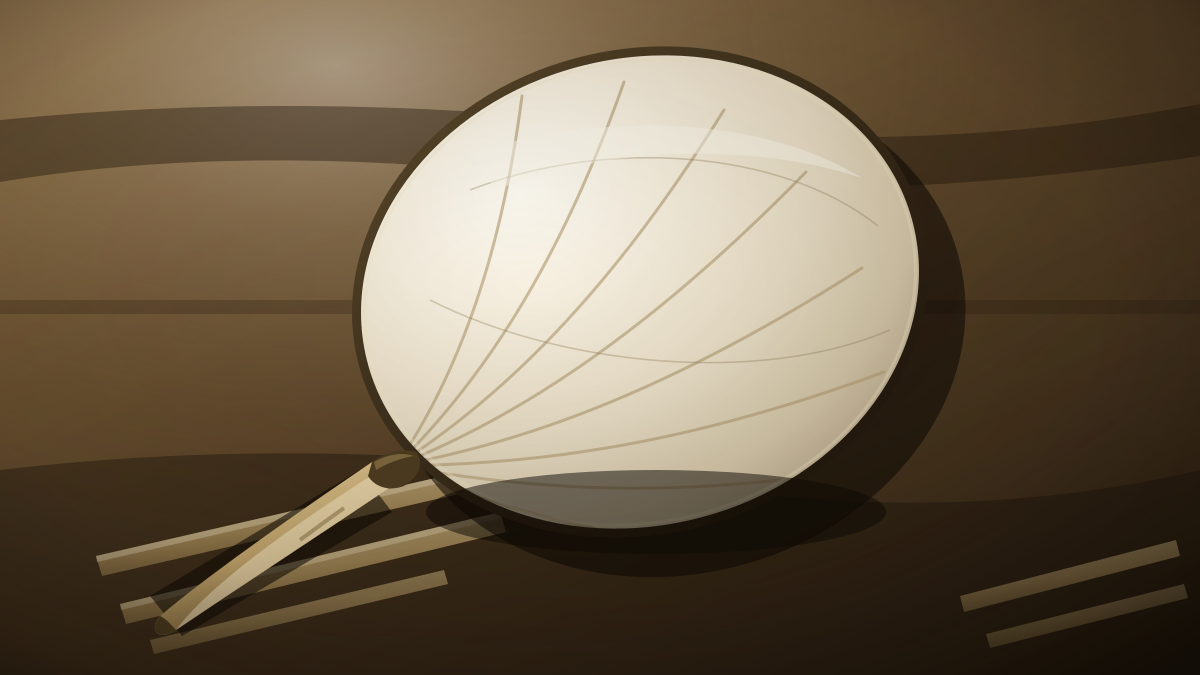 Illustration — not a photograph
Marugame Uchiwa Fan Craft Workshop
Little knownMarugame, Kagawa — about 24 km from Takamatsu Station in a straight line. Half a day on site, under ¥1,000.
Yachimun no Sato
Little knownYomitan, Okinawa — about 23 km from Naha (Kencho-mae) in a straight line. Half a day on site, free to enter.
Shigaraki Ceramic Cultural Park
Little knownKoka, Shiga — about 22 km from Otsu Station in a straight line. Half a day on site, free to enter.
Gyokusendo
Little knownTsubame, Niigata — about 30 km from Niigata Station in a straight line. An hour or less on site, free to enter.
Imbe Bizen Ware Village
Little knownBizen, Okayama — about 24 km from Okayama Station in a straight line. Half a day on site, free to enter.
Tekiseisha
Little knownNinohe, Iwate — about 53 km from Morioka Station in a straight line. An hour or less on site, free to enter.
Further out, and worth the trip
12 spots
Markets, produce stands and shopping districts an hour or more from a hub, including the ones that really want a car. These are where local food and local goods are cheapest and freshest, and where the stock is genuinely regional rather than a national selection. Go early, take cash, and check the day of the week — rural markets often run on fixed days rather than daily. Parking is usually easy out here, which is the compensation for the drive, and the produce is the thing to buy rather than the souvenirs.
Mikimoto Pearl Island
Little knownToba, Mie — about 42 km from Chubu Centrair Airport in a straight line. Half a day on site, a few thousand yen.
Toba Marine Terminal
Little knownToba, Mie — about 42 km from Chubu Centrair Airport in a straight line.
Showa no Machi
Little knownBungotakada, Oita — about 39 km from Oita Station in a straight line. Half a day on site, free to enter.
 Illustration — not a photograph
La Collina Omihachiman
Little knownOmihachiman, Shiga — about 26 km from Otsu Station in a straight line. Half a day on site, free to enter.
 Illustration — not a photograph
Nakatsugawa Kurikinton
Little knownNakatsugawa, Gifu — about 67 km from Nagoya Station in a straight line. An hour or less on site, under ¥1,000. Worth timing for autumn and winter.
Okado Somen
Little knownTonami, Toyama — about 23 km from Toyama Station in a straight line. An hour or less on site. Worth timing for spring, autumn and winter.
Nanamachi Morning Market
Little knownOno, Fukui — about 25 km from Fukui Station in a straight line. An hour or less on site, free to enter. Worth timing for spring and autumn.
Katsuura Morning Market
Little knownKatsuura, Chiba — about 66 km from Haneda Airport in a straight line. Half a day on site, free to enter.
Kawaba Denen Plaza
Little knownKawaba, Gunma — about 41 km from Takasaki Station in a straight line. Half a day on site, free to enter.
Kure Taishomachi Market
Little knownNakatosa, Kochi — about 39 km from Kochi Station in a straight line. An hour or less on site, free to enter. Worth timing for spring and autumn.
Tatehana Wharf Morning Market
Little knownHachinohe, Aomori — about 78 km from Shin-Aomori Station in a straight line. Half a day on site, free to enter. Worth timing for spring, summer and winter.
Katsuyama Preservation District
Locally knownManiwa, Okayama — about 51 km from Okayama Station in a straight line. Half a day on site, free to enter.