
Oshino Hakkai
Researched and written by Hinato

Photo: 663highland / Wikimedia Commons (CC BY-SA 4.0) · original
Oshino Hakkai rewards patience — the view most people describe isn't the one you get by rushing.
Oshino Hakkai is a collection of eight crystal-clear ponds fed by snowmelt from Mt. Fuji that has filtered through underground lava layers for decades before emerging as spring water of exceptional purity. The ponds range from 4 to 8 meters deep, and their water is so transparent that you can see individual pebbles at the bottom along with rainbow trout swimming in the currents. The largest pond, Wakuike, produces 2.4 million liters of water daily at a constant 13°C year-round.
The site has been a sacred pilgrimage destination since the Edo period, with each pond associated with protective deities. The village retains traditional thatched-roof houses (kayabuki) and water mills powered by the spring outflow. The water is considered some of Japan's finest — visitors can drink directly from designated spots, and locals still use the ponds for washing vegetables and cooling watermelons in summer. The view of the ponds with Mt. Fuji rising behind creates one of Yamanashi's most photographed compositions.
Before you go
Access hours
Pond areas 24/7. Hannoki-Bayashi museum 9:00 AM – 5:00 PM.
Closed: Open year-round
Entry fee
Pond access free. Hannoki-Bayashi museum ¥300. Water tasting free. Parking ¥300 (weekends and peak season).
Best time to visit
Year-round; morning (7:00–9:00) for Fuji visibility before tour buses; autumn (October–November) for maple-framed pond reflections
Time to allow
1–2 hours for all eight ponds and main village; add 30 minutes for museum
How to reach it
Directions
Beyond the guidebook
Nearby Spots
The closest hidden gems to Oshino Hakkai, by straight-line distance.
 Illustration — not a photograph
Lake Yamanakako
Little knownLake Yamanakako, the largest and highest-elevation (980m) of the Fuji Five Lakes, stretches 6.8km east-west with the sou…
 江戸村のとくぞう / CC BY-SA 4.0
Kitaguchi Hongu Fuji Sengen Shrine
Little knownKitaguchi Hongu Fuji Sengen Shrine has served as the traditional starting point for Mt. Fuji pilgrimages via the Yoshida…
 1i1ian / CC BY-SA 4.0
Chureito Pagoda
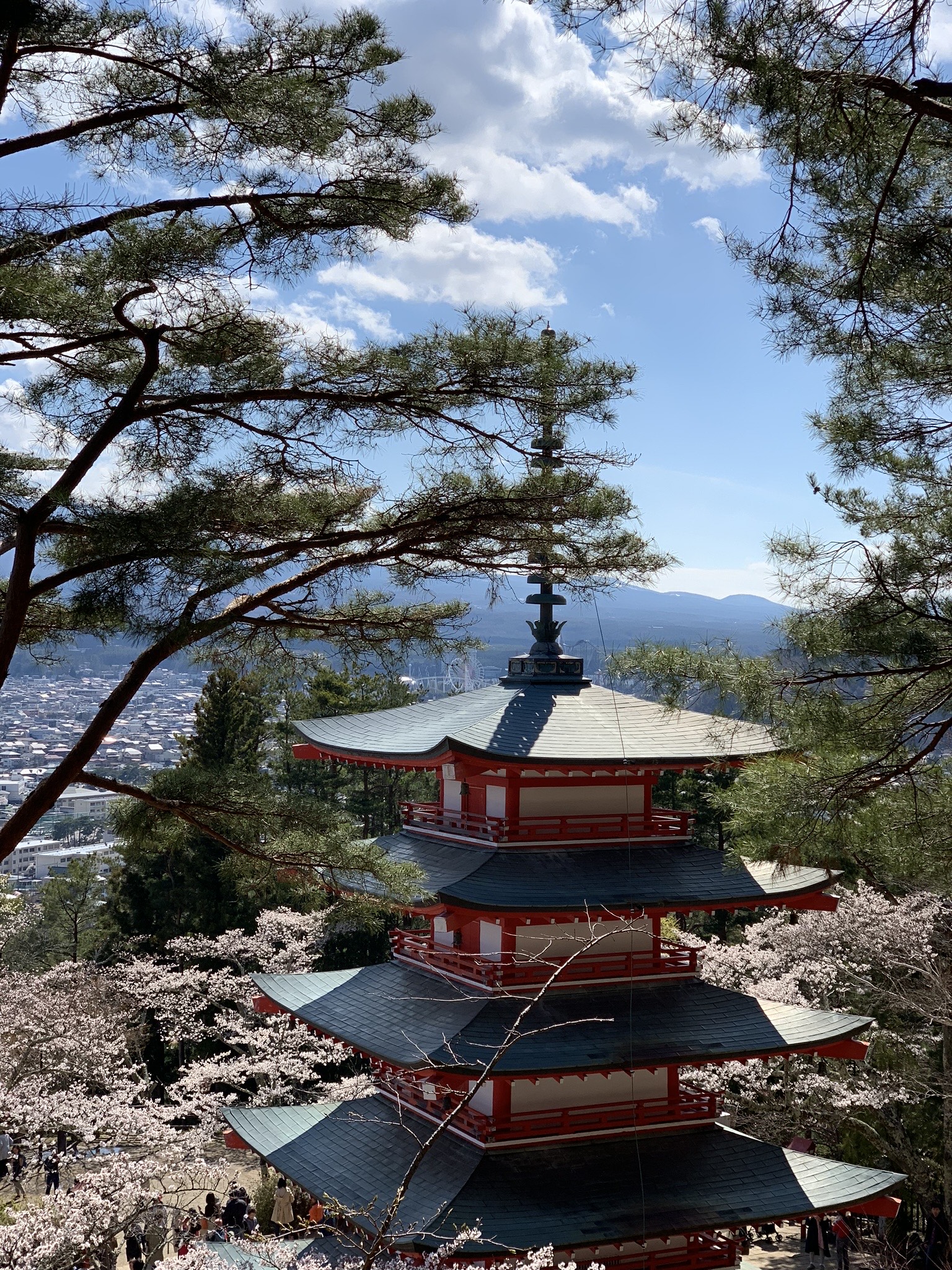
FamousThe Chureito Pagoda, a five-story vermillion structure perched on the hillside above Fujiyoshida City, offers the postca…
Lake Kawaguchiko
FamousLake Kawaguchiko is the most accessible and developed of the Fuji Five Lakes, offering the clearest reflection views of…
Momiji Kairo Maple Corridor
Little knownThe Momiji Kairo (紅葉回廊, 'Maple Corridor') is a 150-meter pathway along the northern shore of Lake Kawaguchiko lined with…
 江戸村のとくぞう / CC BY-SA 4.0
Kawaguchiko Music Forest Museum
Little knownThe Kawaguchiko Music Forest Museum is a European-style garden and music box museum set against the backdrop of Mt. Fuji…
More in Yamanashi
Kofu Wine Wineries
Little knownKofu Basin in central Yamanashi is Japan's premier wine-producing region, responsible for 40% of domestic wine productio…
Takeda Shingen Historical Sites
Little knownTakeda Shingen (1521–1573) was one of the most formidable daimyo of Japan's Warring States period, ruling Kai Province (…
 Illustration — not a photograph
Hoto Noodles
Little knownHoto is Yamanashi's signature comfort dish — thick, flat wheat noodles simmered in a miso-based broth with kabocha squas…