
Aokigahara Forest
Researched and written by Hinato

Photo: ajari from Japan / Wikimedia Commons (CC BY 2.0) · original
Aokigahara Forest looks different depending on the season, the weather, and the time of day — none of which a single photo can tell you.
Aokigahara, also known as the 'Sea of Trees' (樹海, Jukai), is a dense virgin forest that spreads across 30 square kilometers of hardened lava flows at the northwest base of Mt. Fuji. The forest grew atop the lava expelled during Fuji's eruption in 864 AD, and the uneven volcanic substrate creates a unique ecosystem where tree roots spread horizontally across the rock rather than penetrating deep soil. The result is an eerie quiet — the dense tree canopy and porous lava absorb sound, creating an almost total silence that disorients visitors.
The forest has developed an unfortunate reputation due to its association with certain tragic activities, but this overshadows its legitimate natural and geological significance. The Aokigahara Nature Trail (1.5km, 45 minutes) and the Bat Cave Trail (2km, 60 minutes) are both well-marked paths maintained by the Yamanashi Prefectural government, offering safe exploration of the lava formations, ice caves, and unique forest ecology. The tree species include hemlock, Japanese cypress, and birch growing directly from cracks in the black lava rock.
Before you go
Access hours
Forest trails 24/7. Narusawa Ice Cave 9:00 AM – 5:00 PM. Fugaku Wind Cave 9:00 AM – 5:00 PM (seasonal hours vary).
Closed: Forest open year-round. Ice cave and wind cave check for winter hours.
Entry fee
Forest trails free. Narusawa Ice Cave ¥350. Fugaku Wind Cave ¥350.
Best time to visit
Year-round; summer for 5–7°C cooler temperatures inside the forest; winter for peak ice cave formations
Time to allow
45 minutes for Nature Trail; 2 hours for full loop + Narusawa Ice Cave
Making the trip
Getting there in detail
What to bring
Nearby Spots
The closest hidden gems to Aokigahara Forest, by straight-line distance.
 Sakaori ( talk ) / CC BY-SA 3.0
Lake Saiko Bat Cave and Forest
Little knownLake Saiko, the fourth-largest of the Fuji Five Lakes, remains the quietest and least developed — no lakeshore hotels, m…
Lake Shojiko and Lake Motosuko
Little knownLake Shojiko (西湖) and Lake Motosuko (本栖湖) are the westernmost of the Fuji Five Lakes, connected by a 2km walking path th…
 江戸村のとくぞう / CC BY-SA 4.0
Kawaguchiko Music Forest Museum
Little knownThe Kawaguchiko Music Forest Museum is a European-style garden and music box museum set against the backdrop of Mt. Fuji…
Momiji Kairo Maple Corridor
Little knownThe Momiji Kairo (紅葉回廊, 'Maple Corridor') is a 150-meter pathway along the northern shore of Lake Kawaguchiko lined with…
Lake Kawaguchiko
FamousLake Kawaguchiko is the most accessible and developed of the Fuji Five Lakes, offering the clearest reflection views of…
 User:rockisdead1979 / CC BY-SA 3.0
Mt. Fuji
FamousMount Fuji (富士山, Fuji-san) at 3,776 meters doesn't just loom over the Kanto plain—it commands it. The Shizuoka side owns…
More in Yamanashi
Daizenji Taisekiji Temple
Little knownDaizenji Taisekiji Temple, nestled in the Katsunuma wine valley, has an unusual claim: it houses a 1,200-year-old wooden…
 江戸村のとくぞう / CC BY-SA 4.0
Kitaguchi Hongu Fuji Sengen Shrine
Little knownKitaguchi Hongu Fuji Sengen Shrine has served as the traditional starting point for Mt. Fuji pilgrimages via the Yoshida…
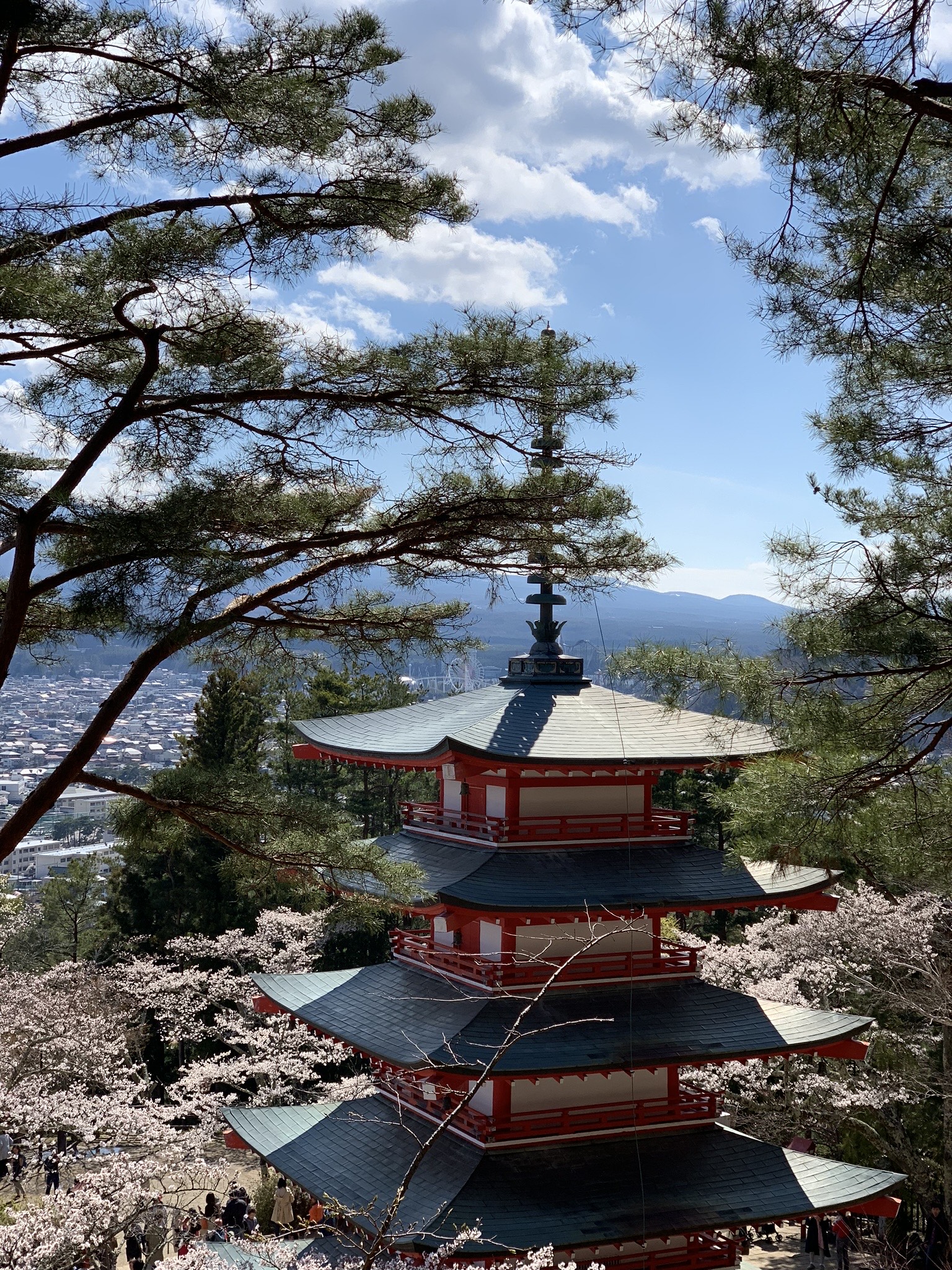 1i1ian / CC BY-SA 4.0
Chureito Pagoda
FamousThe Chureito Pagoda, a five-story vermillion structure perched on the hillside above Fujiyoshida City, offers the postca…