
Gunkanjima (Battleship Island)
Researched and written by Hinato
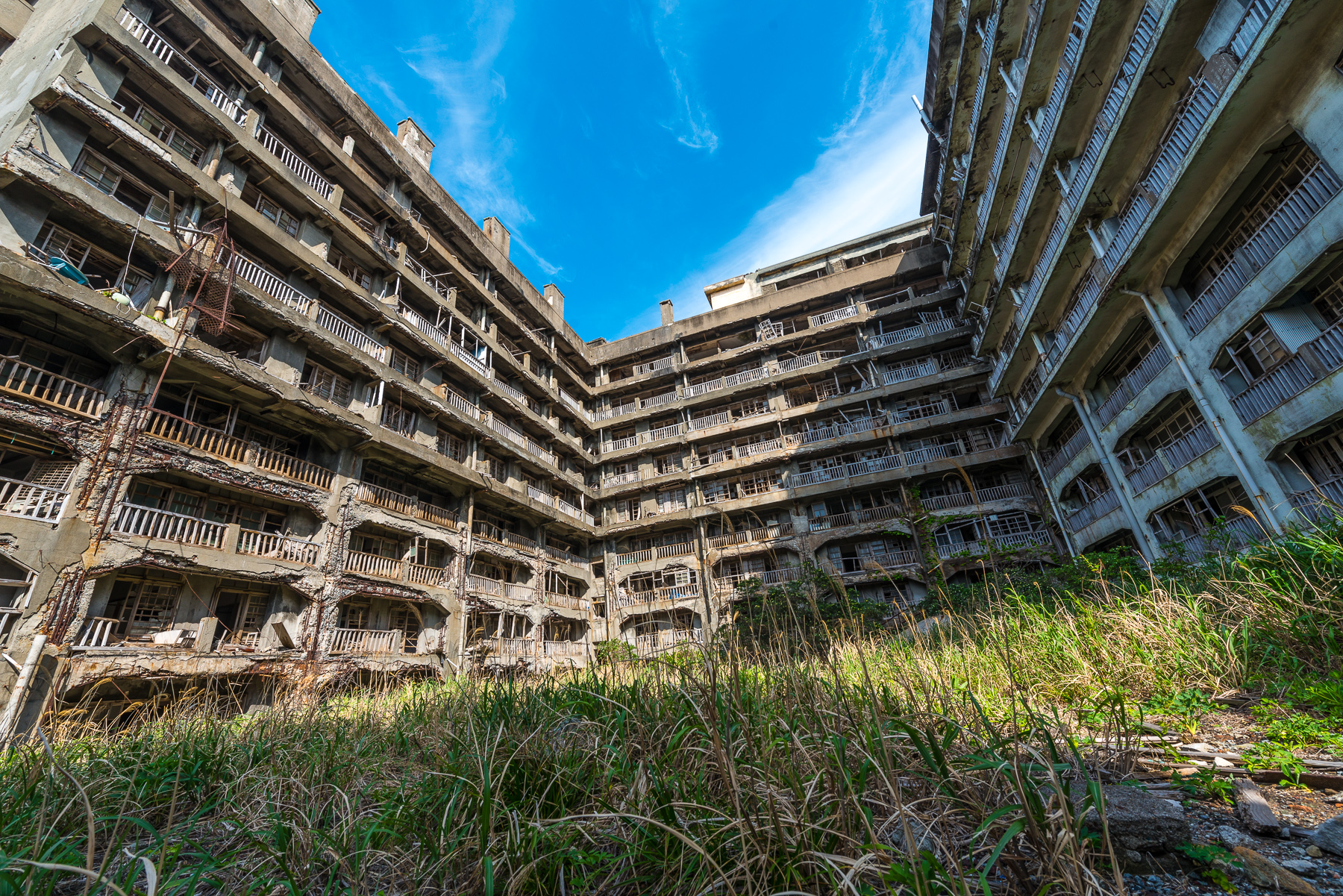
Photo: Jordy Meow / Wikimedia Commons (CC BY-SA 3.0) · original
Gunkanjima (Battleship Island) has outlasted the version of Nagasaki it was originally built for, and it shows.
Hashima Island, universally known as Gunkanjima (Battleship Island) for its silhouette resembling a warship, is a 6.3-hectare concrete fortress that once housed 5,259 people — the highest population density ever recorded on Earth. From 1887 to 1974, the island was an undersea coal mining facility operated by Mitsubishi. When the coal reserves depleted, the entire population evacuated in a single day, leaving the concrete apartment blocks, schools, hospitals, and entertainment halls to 50 years of typhoons and salt corrosion.
The island is now a UNESCO World Heritage Site and accessible only by authorized tour boat. The permitted landing area is a small section of the southern concrete seawall; the rest of the island is off-limits due to structural instability. What visitors see from the designated viewing platform — rows of skeletal concrete towers, stairways to nowhere, and the collapsed dome of the central meeting hall — is among the most dystopian landscapes accessible in Japan.
What to know before you go
When to go
April–September for highest island landing success rate | Morning departures (9:00 AM) for calmest seas
Opening hours
Tour boats: typically depart at 9:00 AM and afternoon slots daily (check operator schedules)
Closed: Tours canceled in rough seas (common October–March) | No fixed closing day otherwise
Time to allow
2.5–3 hours total tour (including 30-minute island landing when conditions permit)
Fee
¥4,000–5,000 per person (tour boat + landing fee, advance booking required) | Gunkanjima Digital Museum alternative: ¥1,800
Reaching the site
Access notes
Beyond the guidebook
Nearby Spots
The closest hidden gems to Gunkanjima (Battleship Island), by straight-line distance.
Oura Catholic Church
Well knownBuilt in 1864 by French missionary Father Petitjean, Oura Church is the oldest surviving Christian church in Japan and a…
 Masoud Akbari / CC BY-SA 3.0
Glover Garden
Well knownGlover Garden preserves nine Western-style mansions from Nagasaki's treaty port era (1859–1899), clustered on a terraced…
 663highland / CC BY 2.5
Nagasaki Champon at Shikairo
Well knownChampon — thick wheat noodles in a milky pork-bone and chicken broth loaded with seafood and vegetables — was invented i…
 663highland / CC BY 2.5
Dejima
Well knownDejima was an artificial fan-shaped island built in 1636 to confine Portuguese traders, and later (1641–1859) served as…
 663highland / CC BY 2.5
Nagasaki Chinatown
Locally knownNagasaki Shinchi Chinatown is Japan's oldest Chinatown, established in the 1690s when the Tokugawa shogunate designated…
Nagasaki Ropeway Night View to Mt. Inasa
Locally knownThe Nagasaki Ropeway, rebuilt in 2020 with new larger cabins, is the definitive way to experience the Mt. Inasa night vi…
More in Nagasaki
Nagasaki Peace Park & Atomic Bomb Museum
Well knownAt 11:02 on August 9, 1945, a plutonium bomb detonated 500 meters above the Urakami Valley, instantly killing an estimat…
 STA3816 / CC BY-SA 3.0
Kujukushima (99 Islands)
Little knownKujukushima ('99 islands,' though actually 208) is a scattering of forested islets across Omura Bay north of Sasebo — a…
 Illustration — not a photograph
Goto Islands
Well knownTake the a boat from Hisaka port to Kashiragashima Island (population: 26) and walk the concrete path uphill past three…