
Day Trip to Mount Koya
Researched and written by Hinato

Photo: 663highland / Wikimedia Commons (CC BY 2.5) · original
A visit to Day Trip to Mount Koya starts before the gate — how you approach it is part of what the site is asking of you.
The cable car climbing Mount Koya tilts at 26 degrees — steep enough that my feet pressed hard against the floor as we ascended through clouds. At 900 meters elevation, the temperature dropped 8°C from Osaka. Stepping onto the platform, the air smelled like wet cedar and incense smoke. This is where Kobo Daishi (the monk Kukai) established Shingon Buddhism in 816, choosing this remote peak specifically because the ring of eight mountains surrounding it resembles a lotus blossom when viewed from above — a natural mandala.
The 2-kilometer walk through Okunoin Cemetery takes 90 minutes not because of distance but because you keep stopping. Between 200,000 moss-covered monuments, I found graves for samurai who died in 1573, a memorial erected by an exterminator company for the insects they've killed, and three monks in burgundy robes chanting sutras at a warlord's tomb. The cryptomeria trees are 300+ years old, their trunks thick enough that three people linking hands wouldn't encircle them. The forest filters sunlight into green-gold columns that shift with passing clouds. At the path's end, Torodo Hall holds 10,000 continuously burning lanterns — the oldest donated in 1088 and still flickering. This isn't a museum. It's where Japanese Buddhism still happens, and you're allowed to witness it.
What to know before you visit
Opening hours
Okunoin Cemetery: 24/7 (always accessible) | Torodo Hall (Lantern Hall): 6:00 AM – 5:00 PM (inner sanctuary) | Cable car: 5:20 AM – 10:10 PM
Closed: No closures for Okunoin. Kongobuji closed for private ceremonies (rare). Cable car maintenance 1-2 days/year.
When to go
Spring (fresh green, fewer crowds) | Autumn (October-November for maple colors) | Winter (snow-covered cemetery is ethereal but cold)
Admission fee
Koyasan World Heritage Ticket (recommended): ¥3,200 round-trip from Namba (includes train, cable car, bus pass) | Okunoin: Free | Kongobuji: ¥1,000 | Danjo Garan: ¥500 | Shojin ryori lunch: ¥2,400-5,000
How long to allow
Full day (10-12 hours round trip from Osaka) | Minimum 8 hours to experience properly
How to reach it
Getting there in detail
Full directions & timing
Nearest Station
Gokurakubashi Station (Nankai Koya Line, end of line) - cable car transfers here to Koyasan | Koyasan Station (top of cable car) - buses to temple area
Travel Time
From Namba: 90 min via Nankai Koya Line + cable car | From Osaka Station: 2 hours via subway + Nankai | Depart Osaka no later than 8:00 AM for full day visit
How to Get There
Train: From Namba Station (Nankai), take Nankai Koya Line Rapid Express to Gokurakubashi Station (80 min, ¥880). Take cable car to Koyasan Station (5 min, ¥530). Take Nankai bus from Koyasan Station to temple area (15 min, ¥330). Koyasan World Heritage Ticket (¥3,200) includes all above plus area bus pass - strongly recommended. No practical car access recommended (mountain roads, limited parking).
Best Time to Visit
Arrive at Okunoin by 9:30 AM before group tours. Early morning (6:00-8:00 AM) in Okunoin for mystical mist among lanterns - requires staying overnight. Weekdays significantly less crowded than weekends.
Crowd Avoidance Tips
Golden Week (late April-early May) and Obon (mid-August) see maximum visitors - avoid or book accommodation 3+ months ahead. Weekday visits 50% less crowded. Early morning arrival requires overnight temple stay (shukubo) - book 2-3 months ahead for overnight. Day trippers have optimal conditions 9:00 AM-3:00 PM.
Parking Information
Limited parking near Gokurakubashi Station (¥1,000/day). No practical parking at temple area (buses required from Koyasan Station). Public transport via Nankai train is the standard and recommended approach.
Beyond the guidebook
Book Your Stay Nearby
Find accommodation close to Day Trip to Mount Koya on these trusted booking platforms:
Nearby Spots
The closest hidden gems to Day Trip to Mount Koya, by straight-line distance.
 Jpatokal / CC BY-SA 4.0
Shojin Ryori
Locally knownShojin ryori is what Buddhist monks eat: no meat, no fish, no eggs, no onions or garlic (they're thought to stir up desi…
 663highland / CC BY 2.5
Koyasan Temple Town
FamousKoyasan sits at 900 meters, a temple town of 117 buildings founded in 816 by Kukai (Kobo Daishi) as Shingon Buddhism's h…
 Nankou Oronain (as36… / CC BY-SA 3.0
Kongobu-ji Temple
Locally knownKongobu-ji (金剛峯寺) is the head temple of Shingon Buddhism and the administrative center of Koyasan's 117 temples, founded…
Okunoin Cemetery Night Walk
FamousOkunoin (奥之院) is a 2-kilometer path through 200,000 moss-covered tombstones and memorial monuments beneath towering 500-…
 米田賢一 / CC BY 3.0
Sanadaan
Little knownAfter Sekigahara in 1600, Sanada Masayuki and his son Nobushige — the man popular history calls Yukimura — were exiled t…
Aragijima
Little knownThe Arida river makes a tight loop around a spur of land at Shimizu, and the terraces cut into that spur have the shape…
More in Osaka
 Tomokazu Kitjaima / CC BY-SA 3.0
Osaka Aquarium Kaiyukan
Well knownOsaka Aquarium Kaiyukan (海遊館) is one of the world's largest aquariums, featuring a massive 5,400-ton Pacific Ocean tank…
 Joli Rumi / CC BY-SA 4.0
Osaka Ramen
Locally knownWhile Osaka is more famous for okonomiyaki and takoyaki, the city has developed distinctive ramen styles blending tonkot…
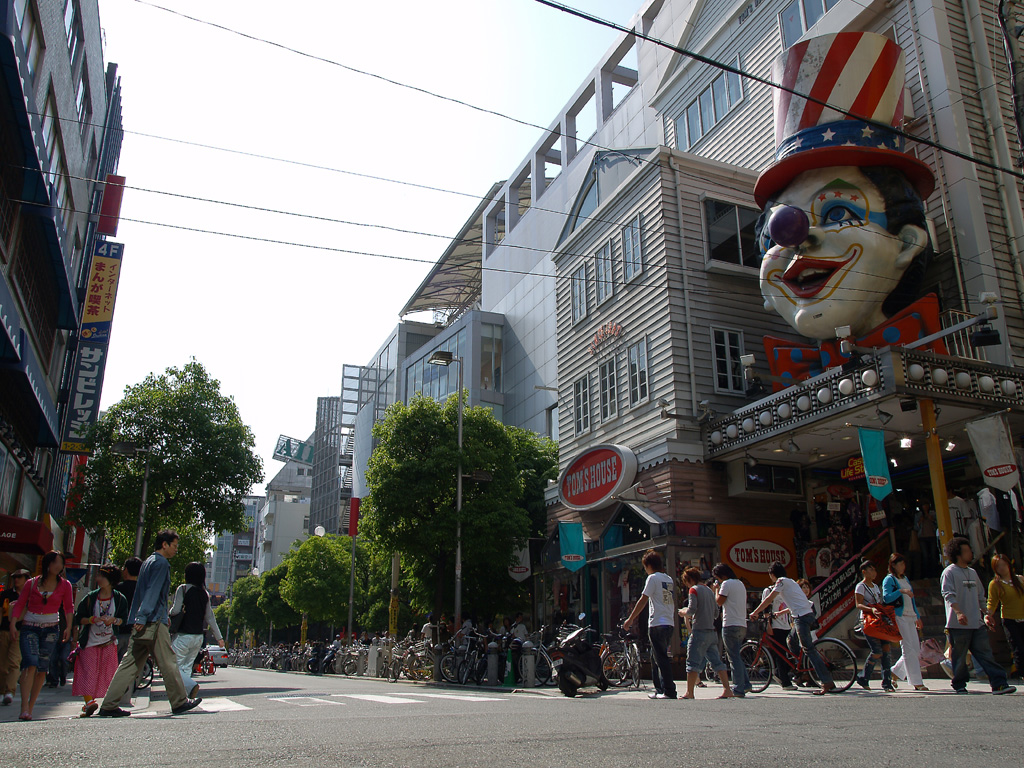 W236 at Japanese Wikipedia / CC BY-SA 3.0
America-Mura
Well knownAmerica-Mura (アメリカ村, 'America Village') is Osaka's youth fashion and subculture district, centered around Triangle Park…