
National Bunraku Theater
Researched and written by Hinato

Photo: z tanuki / Wikimedia Commons (CC BY 3.0) · original
National Bunraku Theater has outlasted the version of Osaka it was originally built for, and it shows.
Three men in black breathe in unison. The one on the left controls the puppet's legs, his body bent at the waist for 30 consecutive minutes without standing. The middle puppeteer operates the left arm using a wooden rod attached to the puppet's hand, his movements synchronized to the millimeter with the chief puppeteer on the right. That senior artist — bareheaded while his assistants wear black hoods to symbolize invisibility — controls the puppet's head and right arm. His left hand reaches into the puppet's skull cavity through a hidden panel, manipulating nine separate strings connected to the eyebrows, eyelids, and mouth.
The puppet is a courtesan about to commit suicide. She weeps — actual tears sliding down wooden cheeks from a tiny reservoir released by the puppeteer's finger. Her eyes track from her lover's face to the dagger in her hand, pupils moving independently. The shamisen player strikes a chord that sounds like fabric tearing. The narrator chants in a voice cracking with grief. In this 90-minute performance of 'The Love Suicides at Sonezaki,' I forgot I was watching wood and fabric. When she died, I heard three people in the audience crying.
Visiting essentials
How long to allow
90 minutes (highlight program) | 4 hours (full program with intermissions)
Best season
Any performance month; June and November runs often feature classic repertoire
Hours
Performance days: typically 11:00 AM and 4:00 PM shows (4-hour programs) | 90-minute highlight program available at some runs | Box office opens 30 min before performance
Closed: Performances only in January, April, June, July/August, and November (3-week runs each). Dark remainder of year.
Admission
¥3,000-6,500 depending on seating tier and program | English audio guide: ¥1,000 (essential) | Advance reservation 1+ months recommended
Reaching the site
Getting there in detail
Full directions & timing
Nearest Station
Nippombashi Station (Sakaisuji/Sennichimae Lines) - 5 min walk | Nipponbashi Station Exit 2
Travel Time
From Namba: 5 min via Sennichimae Line | From Osaka/Umeda: 20 min via Midosuji Line + transfer | From Kyoto: 50 min via JR Kyoto Line + Metro
How to Get There
Train: Take Sennichimae Line or Sakaisuji Line to Nippombashi Station (Exit 2), 5-minute walk south to theater. From Namba: Walk north on Nippombashi-dori (8 min) or take Sennichimae Line one stop. Taxi: 5 min from Namba area (¥800-1,000).
Best Time to Visit
Book seats in rows 3-8 (front center) for best view of puppet facial expressions and puppeteer hand movements. 11:00 AM shows allow daytime visit without evening commitment. English audio guide pick-up at theater entrance - arrive 20 min early.
Crowd Avoidance Tips
Performances book out 1-2 months ahead for popular programs (January New Year, November autumn). Weekday performances have better seat availability than weekend shows. Check National Bunraku Theater website for current season schedule - performances are not continuous throughout year.
Parking Information
Limited coin parking near theater: ¥400/30 min. Namba and Shinsaibashi area parking (10-min walk): ¥300-400/30 min. Subway recommended as Nippombashi area parking is limited and expensive.
What locals know
Book Your Stay Nearby
Find accommodation close to National Bunraku Theater on these trusted booking platforms:
Nearby Spots
The closest hidden gems to National Bunraku Theater, by straight-line distance.
 Immanuelle / CC BY 4.0
Den Den Town
Locally knownDen Den Town (でんでんタウン, short for 'denki no machi' 電気の街 'electric town') is Osaka's answer to Tokyo's Akihabara — a distr…
 Choi2451 / CC BY-SA 3.0
Kuromon Market
FamousKuromon Ichiba Market (黒門市場, 'Black Gate Market') is a 580-meter covered arcade with 150+ vendors selling fresh seafood,…
 BradBeattie / CC BY-SA 3.0
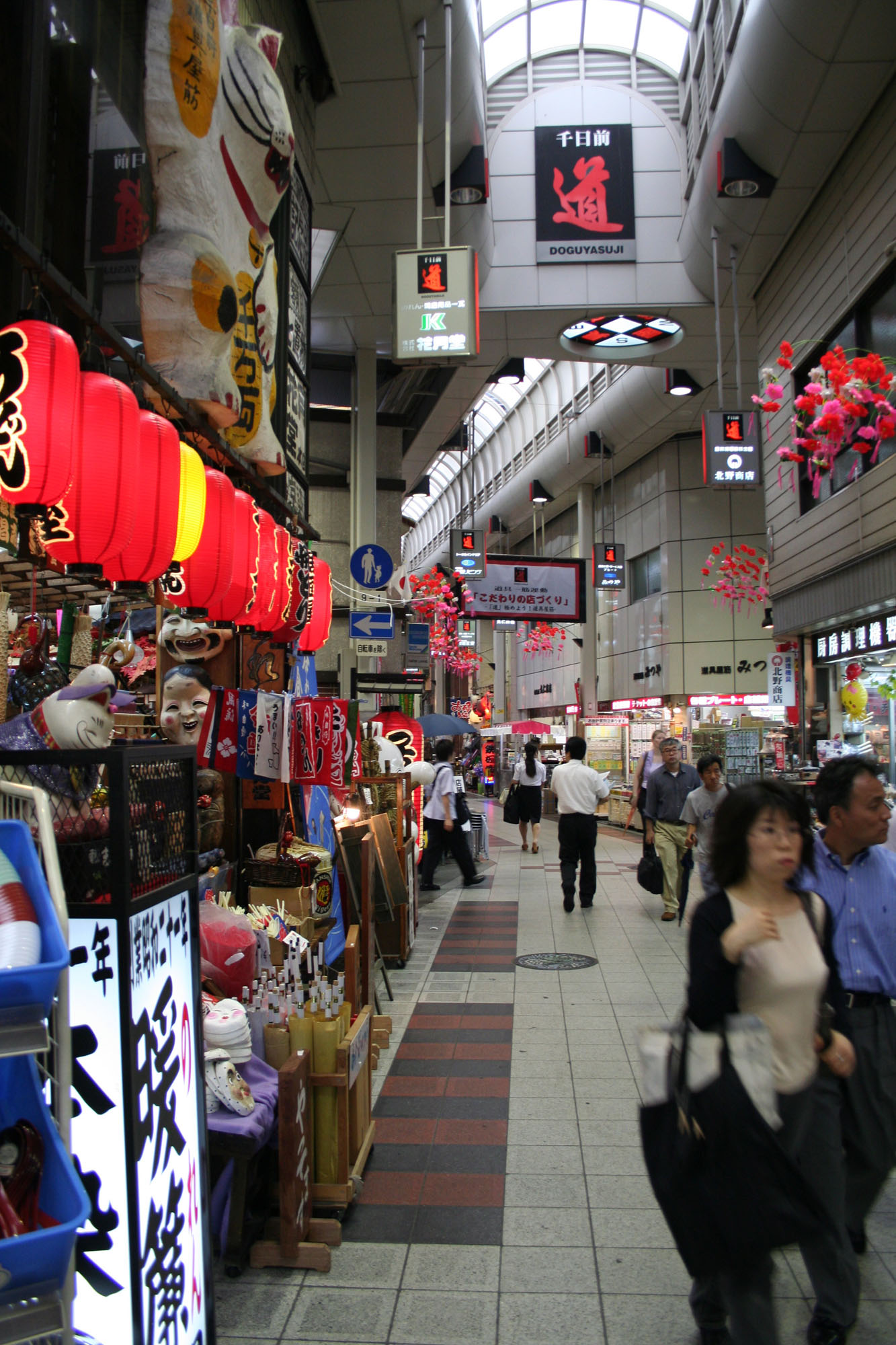
Sennichimae Doguyasuji
Locally knownSennichimae Doguyasuji (千日前道具屋筋商店街) is a 150-meter covered arcade specializing in professional kitchen equipment, tablew…
 Ajay Suresh from New York, NY, USA / CC BY 2.0
Kushikatsu Deep Dive
Well knownKushikatsu (串カツ, 'skewer cutlet') goes beyond simple deep-fried food — it's Osaka working-class culture made edible. The…
 Illustration — not a photograph
Shinsekai & Tsutenkaku Tower
FamousShinsekai (新世界, 'New World') is Osaka's retro entertainment district built in 1912, designed to evoke Paris (northern se…
 そらみみ / CC BY-SA 4.0
Spa World
Locally knownSpa World (スパワールド世界の大温泉) in Shinsekai is an 8-floor onsen (hot spring) complex themed around world bathing cultures — Eu…
More in Osaka
 z tanuki / CC BY 3.0
Osaka Castle
FamousOsaka Castle (大阪城) was built by warlord Toyotomi Hideyoshi in 1583 as headquarters for his unification of Japan. The cur…
 ume-y / CC BY 2.0
Okonomiyaki
Locally knownOkonomiyaki (お好み焼き, 'grilled as you like it') is Osaka's soul food — a savory pancake made from cabbage, batter, and top…
 kanesue / CC BY 3.0
Umeda Sky Building
FamousUmeda Sky Building (梅田スカイビル) is a twin-tower skyscraper connected at the top by a 'Floating Garden Observatory' (空中庭園展望台…