
Kanoya Rose Garden
Researched and written by Hinato

Kagoshima's geography does a lot of the work at Kanoya Rose Garden — the rest is knowing when to show up.
Kanoya Rose Garden (かのやばら園) is one of Japan's largest rose gardens with 50,000 bushes representing 1,500 varieties spread across 8 hectares of hillside overlooking Kanoya Bay. The garden blooms twice annually — spring (late April–early June) and autumn (late October–early December) — with peak colors and fragrance in May and November.
The garden uses terraced hillside to create 'walls' of roses in cascading color gradients — red fading to pink to white to yellow.
Visiting essentials
Best season
Spring peak: May 10–25. Autumn peak: November 1–15. Check weekly bloom reports on the garden website before visiting.
How long to allow
1.5–2 hours to walk the terraced hillside gardens and photograph the color-gradient rose sections
Hours
9:00 AM – 5:00 PM
Closed: Open daily year-round (off-season has minimal blooms and reduced entry fee)
Entry fee
¥620 (peak bloom season). ¥310 (off-season).
Getting out there
Directions
Beyond the guidebook
Nearby Spots
The closest hidden gems to Kanoya Rose Garden, by straight-line distance.
 Ippukucho / CC BY 3.0
Arahira Tenjin
Little knownA small shrine to Sugawara no Michizane, the deity of learning, built on top of a rock outcrop just offshore in Kinko Ba…
Cape Toi (Misaki Horses)
Little knownCape Toi (Toi Misaki) is famous for its free-roaming Misaki horses — one of Japan's eight native horse breeds. Around 10…
 Sanjo / CC BY-SA 4.0
Ogawa Falls
Little knownForty-six metres high and sixty wide, falling into a pool of an improbable emerald green enclosed by columnar basalt wal…
 NY066 / CC BY-SA 3.0
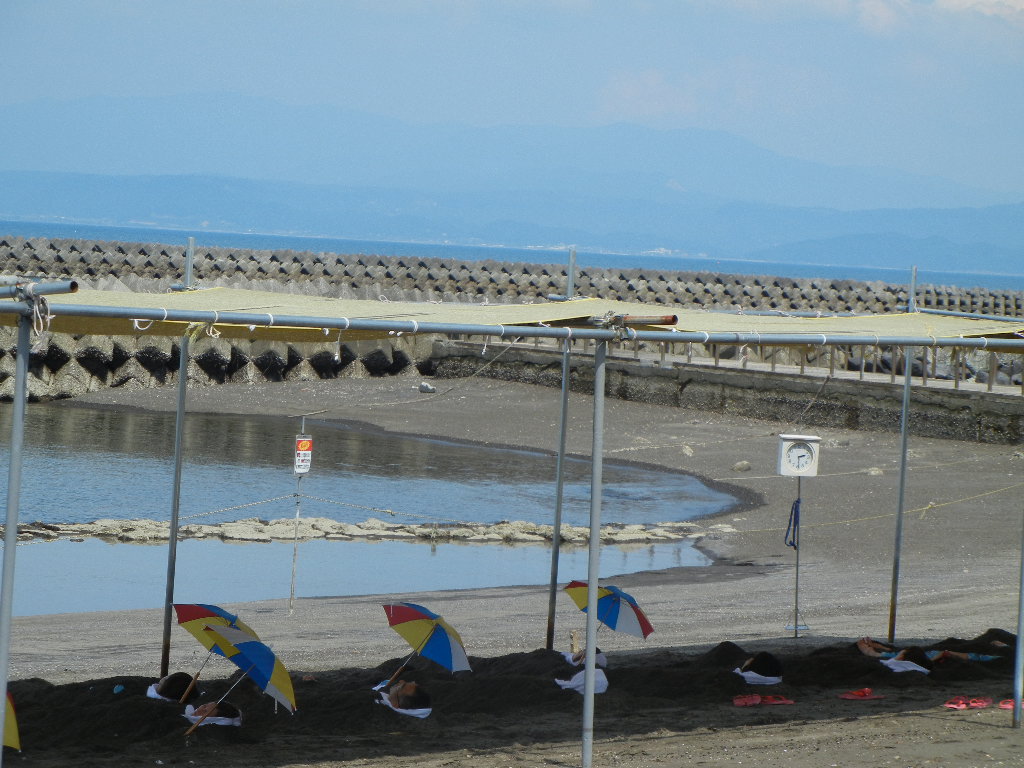
Ibusuki Sand Bath
Well knownIbusuki is famous for sunamushi onsen (砂むし温泉) — hot sand baths where attendants bury visitors up to the neck in naturall…
 ::::=UT=:::: / CC BY-SA 3.0
Sakurajima Active Volcano
Well knownSakurajima is one of the world's most active volcanoes, erupting thousands of times per year — smoke plumes and ash fall…
 Ray_go / CC BY-SA 3.0
Fukuyama Kurozu Tsubobatake
Little knownKurozu is black rice vinegar, and Fukuyama has been making it the same way since around 1800: steamed rice, koji and spr…
More in Kagoshima
Amami Oshima
Little knownAmami Oshima is a large subtropical island 380km south of mainland Kagoshima, closer to Okinawa culturally and ecologica…
 MaedaAkihiko / CC BY-SA 4.0
Kirishima Shrine
Well knownKirishima Jingu is a Shinto shrine complex set deep in the forested slopes of the Kirishima volcanic range, dedicated to…
 Hyppolyte de Saint-Rambert / CC BY 4.0
Sengan-en Garden
Well knownSengan-en is a vast feudal lord's garden (50,000 m²) created in 1658 by the Shimadzu clan — rulers of Satsuma Domain for…